These days meta descriptions rarely matter. Google is going to pick the most relevant paragraph from your website or might even summarize your content to create whole new meta descriptions.
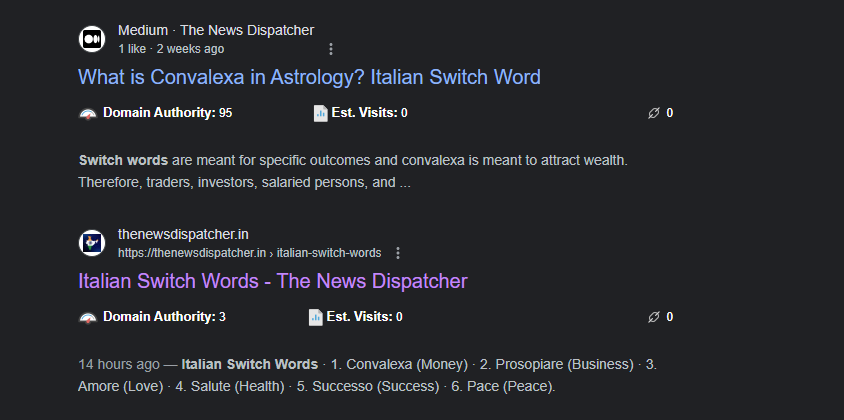
The following are the search results for the term “Italian switch words” for which my articles are #ranking on #4 and #5.
Meta Descriptions for 4th and 5th Results of Search Term: Italian Switch Words
The first meta description was mine. But the second was generated by Google itself.
If you take a closer look, you might notice that the second meta description is a list which was not the meta descriptions that I put.
Why Does This Happen?
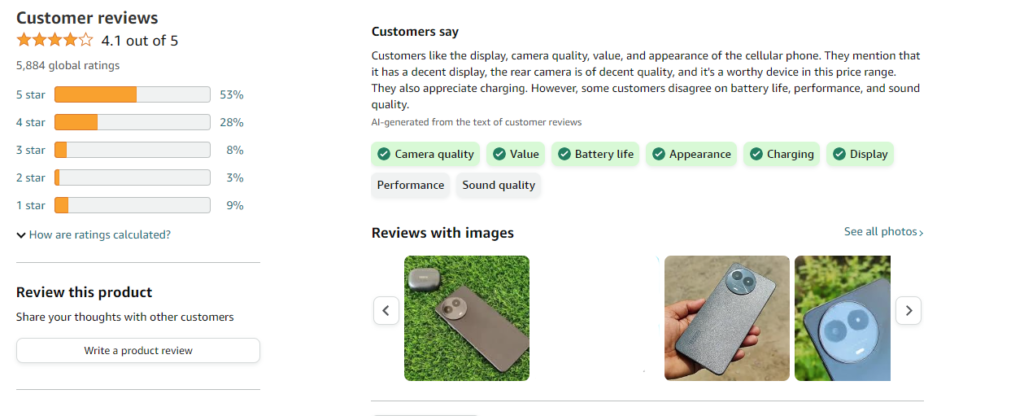
Since Google has developed multiple AI algorithms of its own, it is increasingly using them to make the search experience better. This includes generating summary of the website content whenever necessary. The same technology is being used by Amazon to provide a summary of user reviews on its website.
Amazon Using AI to Summarize Reviews
Is This Harmful For Me?
No, this is not harmful because this will help you rank your article for multiple terms. Google will modify meta descriptions based on suitability with the search term.
Overall, this feature of Google search will only increase your ranking for similar keywords. But, do always remember to write content which are meant to help humans.
Should You Keep Adding Meta Descriptions?
Yes, adding meta descriptions rarely take more than 1 minute if you are an experienced writer like me. This would add to the user experience.
Further, if your meta descriptions are helpful for any search term, it would contribute to your Google rankings.
Frequently Asked Questions
What should I include in a meta description?
Meta descriptions should seek to answer the search intent as directly as possible.
What is the Standard Meta Description Length?
The width of meta description for a website on Google search is around 900 pixels which is around 150 characters. However, I would suggest you to keep it under 140 because of my experience as an SEO.
Overall using AI content is good and even sometimes Google like it. Google now views content as either high quality or low quality and does not care how it has been produced.
However, to perform well on SEO and get organic traffic from Google, you need to make sure of two things:
Your content is helpful.
It adds some real information to the internet.
1. Ensuring AI Content is Helpful
An easy way to ensure if your content is helpful or not, is by checking its demand. There are several ways how you can see if there is a demand for a type of information.
Google Keyword Planner
Keyword Research Tools like Ubersuggest, Ahrefs and SEMrush.
Question-Answer websites like Quora, Also Asked, People Also Ask, etc.
Google Trends
List of All Factors That Contribute To Helpful Content
Original Information, Reports, Research or Analysis
Substantial Or Comprehensive Description of the Topic
Insightful Analysis
Interesting Information
Even if its not an original topic, does it add more value to existing information.
A good title and description. Do not add suspense here. Reveal everything.
Avoid exaggeration and clickbaits.
A page that someone could bookmark or share with others.
Something which could be referenced by another publisher. In SEO, we call these as “Linkable Assets”.
Gives the reader a satisfying experience and they do not need to read more.
2. Ensuring Real Value Addition in AI Content
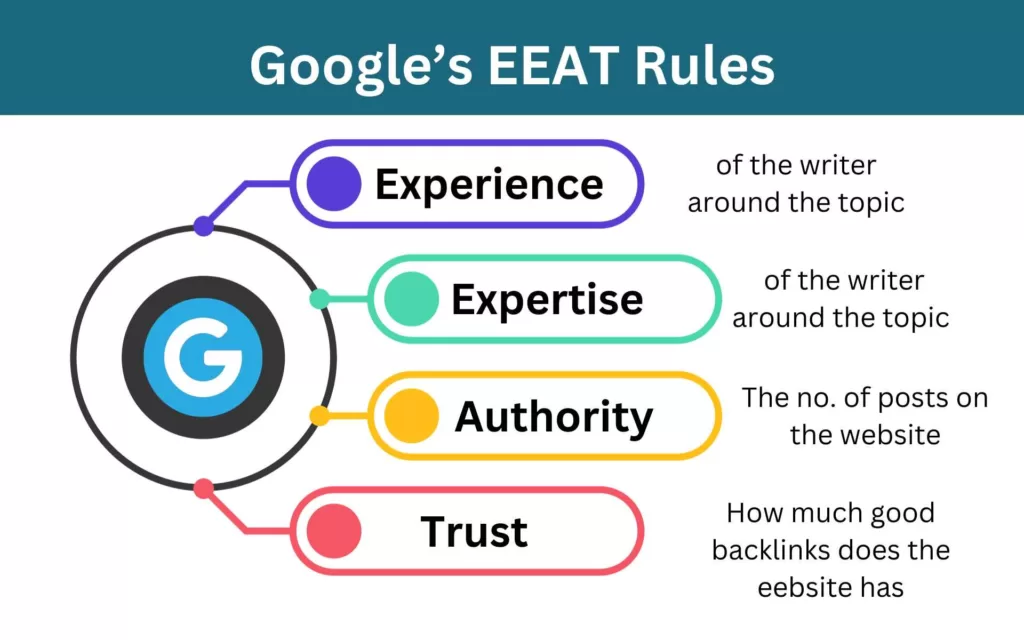
What makes an information rank-able on Google is that it adds some real value to the already present information on the internet. The content has to ensure it is useful, helpful, original and satisfies the EEAT Rules.
Google EEAT Rules
This is where most GPTs get it wrong. They just spin content. So rather than asking it to write an article, ask for an advice or give it a situation.
For example, I am an SEO and has recently discovered a fast ranking technique. Let’s assume this information is not available on the internet.
Therefore, Google has no choice but to feature my article at the top. However, I have seen that the process is a little slow. (Indexing>Backlinks>Helpful Update>Ranking)
Few Tips That Help Me Create EEAT Content
Viewers should be able to see who wrote the content.
Pages need “byline” which provide additional information like: Also Read, Note, Suggestion, etc.
Declare that the content was AI generated, wholly or partially.
Content shows first hand knowledge. Add personal experiences here.
Content aligns with the primary purpose of the website.
Frequently Asked Questions
Does Google punish AI content?
Yes, but only when you are mass producing AI article with little or zero value addition.
Does Google index and rank AI content?
Yes, as long as the content is helpful in some way Google has no problem in indexing and ranking.
Can a blog rank in Google with translated or AI generated content?
Yes, if there is no other valuable piece of human created information, Google has no choice but to rank an AI generated article.
How can I give a human touch to my AI generated content?
There is a simple way of adding human touch through personalized experiences which helps Google know that the content was generated under expert supervision and it would help someone.
Sitemaps are an easy way to index your website on Google and Bing. Once you submit a sitemap through a sitemap generator, it automatically picks up new pages and posts as they are published on your website.
However, uploading the wrong sitemaps can cause delays in your website getting index and therefore delay your SEO results. This article will act as a guide on how you can make the best use of sitemaps for your website’s SEO.
Sitemaps provide guidance to crawler bots sent by Google to index websites. The sitemaps provide them with an easy guide on which pages, posts, videos, web stories, etc., are live on your website.
However, sitemaps also cause delays in getting your website indexed. This is because of a presence of a lot of tags on websites which I have witnessed is a common thing on WordPress, Shopify, SquareSpace, and other similar codeless website builders.
These tags cause delays because sitemaps show them as independent pages. Now when these tags are getting indexed, other much important pages present on your websites face delays in indexing.
Therefore, I have prepared the following guide with my 2 years of SEO experience, on how you can make the best use of sitemaps to get your website index in a fast way.
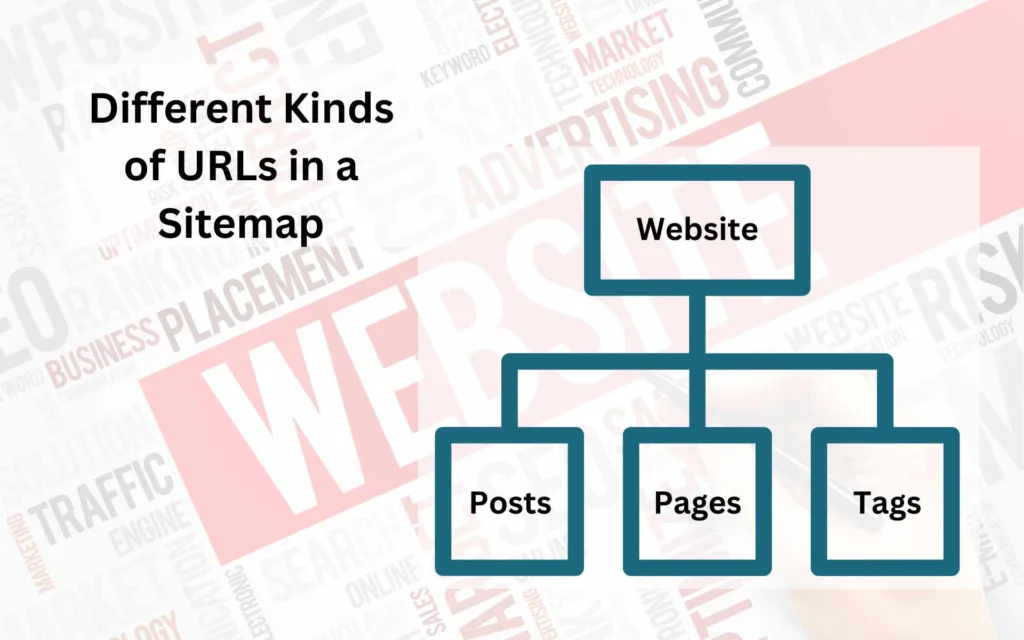
Different Kinds of URLs Present in a Sitemap
5 Tips for Submitting Sitemaps on Google Search Console
1. News, Content Publishers and Blogs
Websites which have a high number of daily articles or websites which have more articles, blogs and posts than pages should submit the “post sitemap” only.
The reason is that the few pages on the website can be easily submitted for indexing directly from the search console bar for URL inspection (on the top).
URL Inspection Bar (on the top) on Google Search Console
2. E Commerce, Online Stores without Blogs
These websites typically have higher number of pages and rarely any articles or posts.
Website owners of these websites can either submit the page sitemap or the full sitemap. The reason is that since these websites have almost zero tags and zero categories, therefore they rarely add any of them into the sitemap.
3. E Commerce, Online Stores with a Blog Section
These websites need to separately submit the Page and Post sitemaps but should never submit the full sitemap as a full sitemap would introduce unnecessary tags and category pages.
Submitting both sitemaps automates the indexing of URLs on these kind of websites.
4. Portfolio Websites
These are the simplest websites and typically contain a few static pages. Sometimes users, like me, post about their areas of expertise on these blogs. These kind of users who post articles and blogs on their portfolio websites should submit different sitemaps for posts and pages.
Otherwise for simpler portfolio websites with low number of pages, can submit a full sitemap.
Frequently Asked Questions
What is a sitemap?
A sitemap is a list of posts, pages, videos, web stories and anything that has its own different URL on a website.
What is the purpose of sitemap?
The purpose of sitemap is to give a clear and defined path for Google crawlers which index your website.
What makes a good sitemap?
A good sitemap is one which is: 1. Frequently Updated 2. Has clear list of pages and posts. 3. Has deleted the previous URLs which no longer exist. 4. Provides a list of redirected URLs
A lot of businesses sell on Amazon and rely on its rankings to make a sale. Search rankings matter a lot to them. An easy way to get higher rankings on Amazon is to know how many people are searching for your product and how you can satisfy those search queries.
In this article, I will explain you how SEO for Amazon can help you get better product rankings and hence make better sales. I will also list a sample product and explain SEO in each step of product listing.
Does SEO work in Amazon?
Yes, SEO is the net sum of all efforts that help a website rank better for any search engine. SEO works fine on all search engines be it Bing, Baidu, Google and Yahoo. A recent data leak from Yandex showed us that the search engine relied on close to 2000 odd factors to determine website ranking.
Amazon SEO too works in a similar way as other search engines, albeit not as strict as Google.
To understand better what matters the most in Amazon’s SEO optimization let us understand what are its priorities and how you can fulfil them.
After all, SEO is the art of giving searchers the information they want through search engines.
How to Ensure Searcher Satisfaction in Amazon?
To rank better on Amazon or any search engine, make sure that you fill all the details about your product is a very organized and easy to understand manner.
Amazon requires a seller to fill the following 4 pages to list any product.
Product Identity
Description
Product Details
Offer
These details are used as a basis for your product’s rankings on Amazon. So when, you are listing any product, make sure you take care of the following things when filling in details.
We have divided our approach into 4 steps where each step is related to a specific product details page on Amazon.
Keyword Research For Amazon
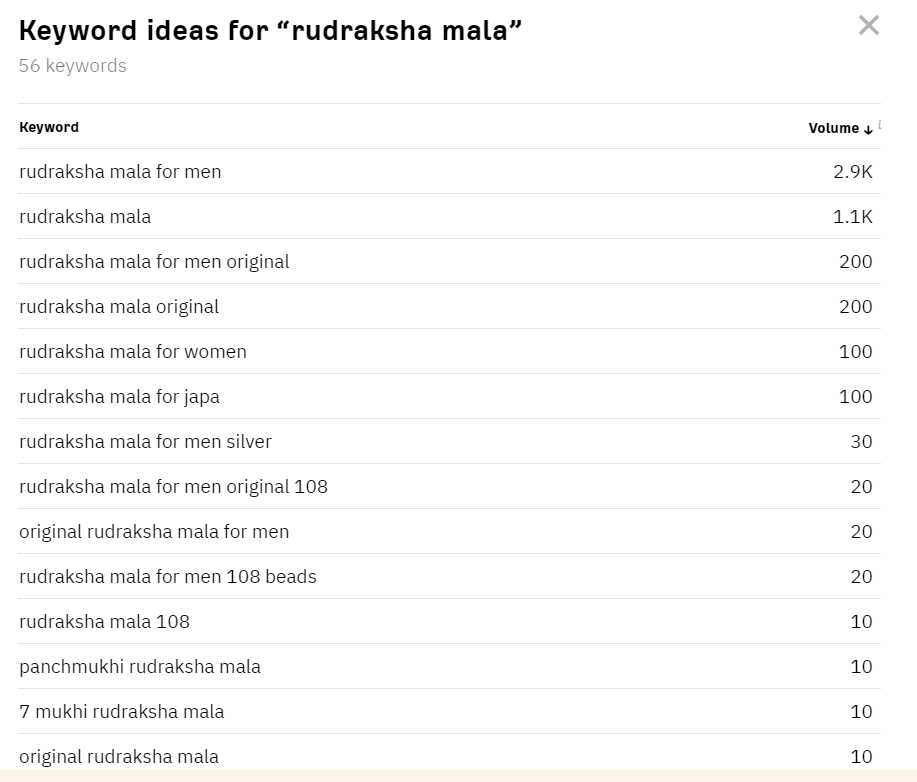
Keyword research is very important to understand how many people are searching for your product online. For Amazon, you can use a free keyword research tool, Ahrefs Keyword Generator.
Below is a sample search result for the term “Rudraksha Mala” on Ahrefs for Amazon.
1. SEO for The Product Identity Page
In the product identity page, include the keyword. For example if your product is around “Rudraksha”, make sure to include its name in a concise but fully understandable manner.
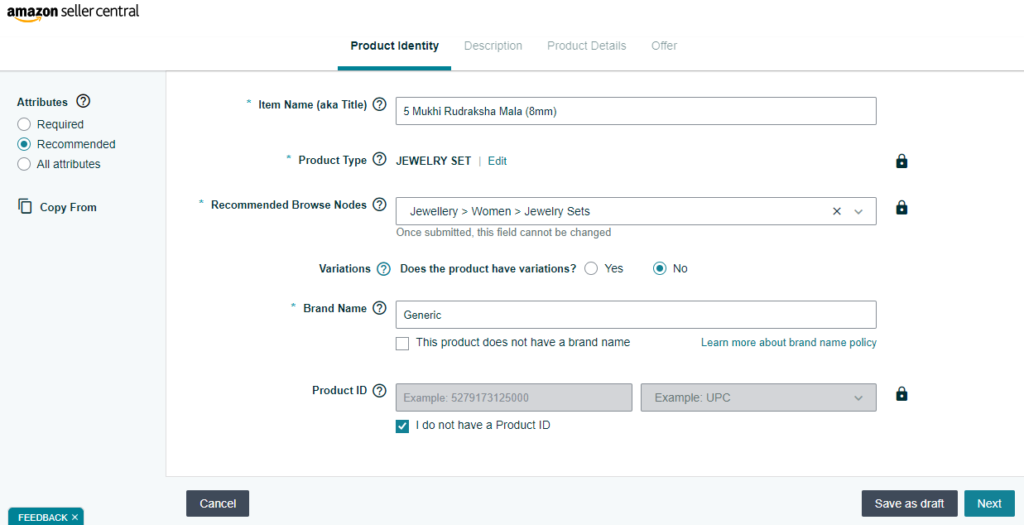
Below is a screenshot of the Product Identity Page. Note that in the title section, I have mentioned the product as ” 5 Mukhi Rudraksha” and not panch mukhi, or 5 face rudraksha. This is because the human mind reads number much faster and helps catch attention. In SEO Titles, we always use numbers wherever possible.
SEO for Product Identity on Amazon
Tips for Product Identity Page
In the title field, use a headline analyzer tool like Capitalize my title to make sure your title is attractive, easy to understand and provides complete information.
Use core keyword only once. If you are selling mobile covers, a good choice could be “5 Mukhi Rudraksha Mala for Men and Women”. In this example, this detail will help searchers understand that the product is unisexual.
2. SEO for The Description Page
This is an important page which can make or break your rankings. Take care of the following SEO points while filling this page. There is a character limit of 2000, which roughly translates to 300 words (6 chars. per word).
Use the keyword (for example mobile covers) only once per 25 words (below 5% keyword density). This ensures that your product not only meets Amazon standards but also gets traffic from Google.
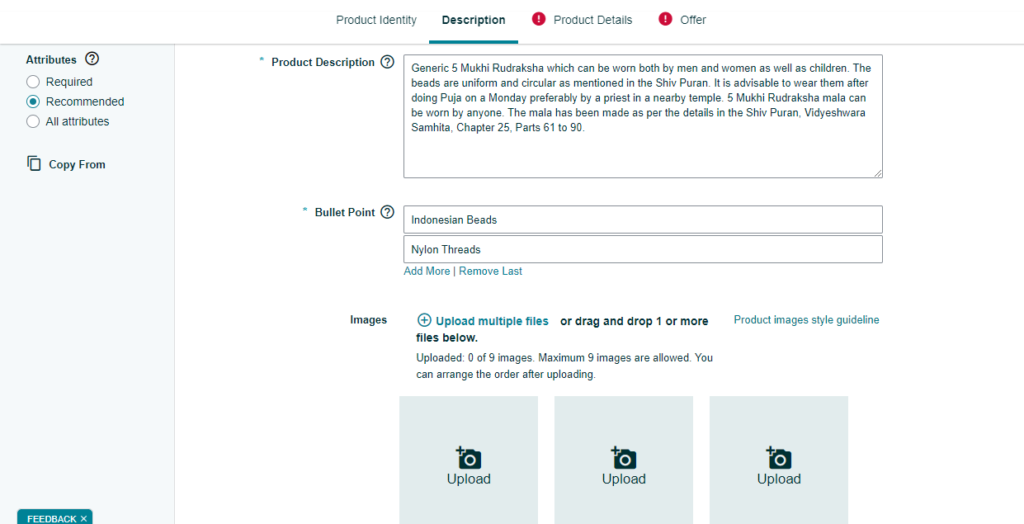
In the second field, include as many bullet points as required (typically 4-5), but be concise and don’t miss any critical detail. You can observe a filled-up sample form below.
Product Description Page SEO on Amazon
You can observe that I have added the product name in the beginning which is a usual SEO suggestion. In the description, I have used the term once more but within the 5% of the total number of words.
I felt that my product needs only two bullet points, so I have added them. The need of bullet points is to present a structured schema to Amazon and Google. Structured schemas help search engines know what type of text is present in which part of the page.
This helps them understand the page better and present it to searchers which helps rank your product faster.
Tips for Description Page
Maintain keyword limit as 5% of the size of the total description.
Include bullet points to summarize description.
3. The Product Details Page
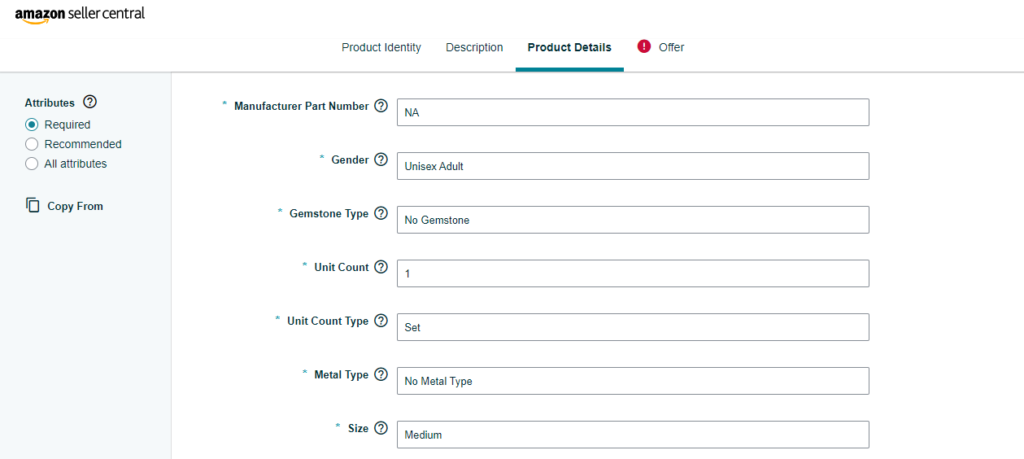
The Product Details page requires you to fill some details about the product. It gives options to fill only required details, recommended details or all details. It is preferable from a SEO perspective that you fill all details. It will add more knowledge about your product which is always better.
Product Details Page SEO on Amazon
Tips for Product Details Page
Fill it with a customer centric view in mind.
4. The Offer Page
The final page is the offer page which helps you create offers for your products to attract more customers. It has little to no impact on SEO.
Tips for Offer Page
Add an offer which is better than your competitors.
Decreasing domain authority means that either your website is loosing backlinks or you are lagging on the SEO maintenance of your website.
In this article we will see what are the factors behind a decreasing domain authority and how you can recover your website from it.
Top Reason – Lost Backlinks
What are Backlinks?
Typically websites remove backlinks because either the information on your website is outdated or someone is providing better information for the same topic.
Another reason why you might be losing backlinks is that your website might be losing its position in Google search. This is typically the case we have seen for websites that provide news or information through data, charts, tables, etc.
Why are Backlinks Important?
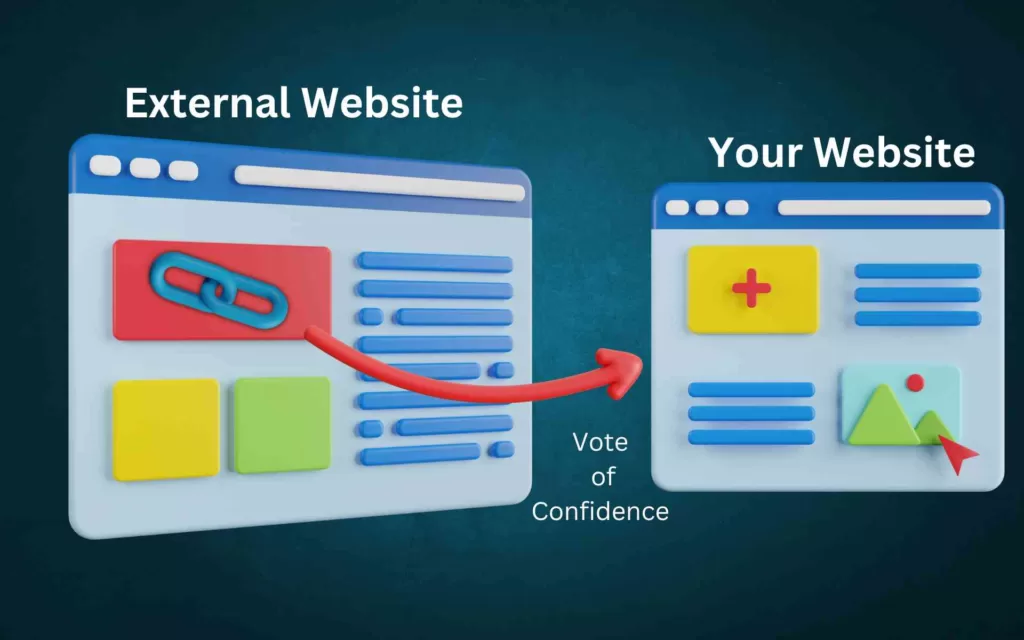
Backlinks constitute a major portion of your domain authority score. They act as a vote of confidence to your website and are one of the four major factors (EEAT) on how Google judges your website.
The greater the number of high quality backlinks your site gets, the higher will be its domain authority. However, adding random backlinks won’t increase your domain authority.
Solutions For Lost Backlinks
The most common solution to compensate for lost backlinks is to acquire new ones from high quality sources.
You can acquire new backlinks from the following sources.
1. Press Release
Press Releases are by far the most effective backlinking tool that I have encountered in my entire SEO career. They are easy to get, are permanent and have the highest quality of links. Further, links from Press Releases also get you a considerable amount of traffic, as the websites where PR is posted are typically high traffic news websites.
2. Guest Posting
How to Identify Websites with High Quality Backlinks?
Belong to the same industry or niche. For example, advertisement websites backlinking to digital marketing websites.
Have a domain authority greater than your website.
Mention your website either by its name, or by a keyword. This keyword has to be a part of your page/post title of the URL which is receiving this backlink.
Do not have a high spam score. We prefer less than 25%.
Are not from websites which have high amount of external links.
3. Podcasts
You can host podcasts and ask your host or guest to share it on their social media. If they have a good following, chances are that your podcast-related article or post will be picked up by some content writer and you will gain some backlinks.
4. Medium
Though many consider Medium to be a social media website and therefore of less link value, but Medium backlinks from high traffic pages give relatively high amount of backlinks to your website.
They also transfer a considerable amount of traffic to you.
5. Wikipedia
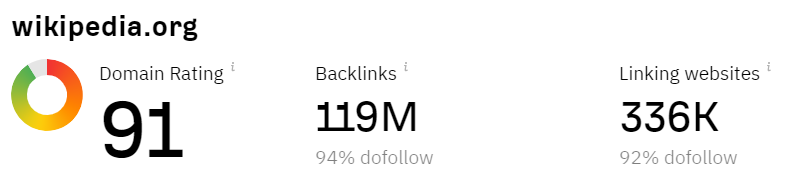
Wikipedia is the hardest website to backlink. Though some websites and SEO claim that their links is of no value, yet even no-follow backlinks from Wikipedia have more link value than even the best news agency websites.
Wikipedia has one of the Highest Domain Authority
Other Common Reasons for Decreasing Domain Authority
1. Common SEO Optimizations
If you forget to update your article from time to time, they lose freshness and Google de-indexes them or decrease their rankings.
Headline and Meta Description optimizations with the keyword of the article.
Lack of proper schema.
2. Spam Backlinks
Spam backlinks are those which are from websites with a high spam score. To check the spam score of any website, you can use this tool, Website SEO Checker. Any spam above 25% should be avoided.
How to remove Spam Backlinks?
Spam backlinks can be removed using a simple trick. You can make a list of URLs that you think have a high spam score. Then you can use the Google Disavow tool to submit the list of these URLs.
Be careful, Google disavow tool is difficult to use and can cause serious damage to your website if wrongly used.
At Ingeniare AI, we can help you disavow spam backlinks for a minimal $10 cost.
3. Lack of Redirection when URL Changes
When you change the URL of an existing page, chances are that you might not have created a proper redirection. Lack of proper redirection leads to lost backlinks which were present in the previous version of the URL.
You should also redirect URLs to new pages when deleting a web-page or merging articles or pages.
4. Buying Old Domains
Old Domains have a lot of backlinks with them. Whenever you buy an old domain, make sure you use the internet wayback machine to check for old URLs and make a list of them. Then you should redirect all the URLs to the root domain.
Backlinks play a major role in local SEO. Since there is not much competition, sometimes even generic backlinks from social media or blogging platforms works fine. But, for high competition localities like metro cities and big towns, you need to create a good content strategy and then backlink from high authority websites.
Backlinks for Low Competition Localities
Our agency did a lot of projects for local SEO and everytime we noticed that generic backlinks worked fine. These backlinks are from social media websites, business listing websites, blogging platforms and similar other websites.
Some of local SEO backlinking ideas are:
Medium
Pinterest
Low DA Websites
Wikipedia
Facebook
Quora
Just remember to keep a non-consistent approach, i.e, create backlinks with different variations of the same anchor text. For example, if your website is related to “mattresses“, keep anchor texts as:
Soft mattress
Cotton mattress
Good mattress
Mattress
Further, wherever possible use a mixture of do-follow and no-follow backlinks.
Note: If your backlink profile looks suspicious, i.e., all the links are created in a short period of time, or all links have the same anchor texts, your chances of getting punished by Google increases by several folds.
Our Successful Case Study
In January 2023, we helped a website for “chhenapoda” within Mumbai. All it required to rank on #2 was:
Backlinks for High Competition localities like metropolitan cities and large industrial towns need to follow the same steps as in typical SEO.
Here, backlinks are created once a well designed content strategy is executed. The backlinks have a focus where they are attached to articles that revolve around the topic for which you wish to rank.
For example, let us say that you wish to rank for “management books” in local SEO.
At first you need a page which contains all the details about management books and also has a store attached to that page.
Then for each book, there has to be a separate page created.
All these pages will contain internal links to the main page “management books”.
There has also to be a list of supportive pages which will exchange links with the main page as well as all the books page.
Then backlinks can be attached to all pages. Doing this all the link juice will end up in the priority page i.e., “management books” and soon you will find you are ranking for the term.
However, before doing anything make sure what your competition does. The more rarely they invest in SEO, the easier it would be for you to rank.
Frequently Asked Questions
Can local businesses benefit from backlinks? How?
Backlinks are very essential to rank on Google. They act as a system of trust transfer. More the number of backlinks from high quality sources, the more would Google prefer your website to rank. Backlinks are a part of Google’s EEAT necessities.
How to get do-follow backlinks?
You can only ask the person who is responsible for posting on the website. Whether they give do follow or no follow backlink, depends on their choice.
What is the best way to build backlinks?
The best way to build backlinks is to do nothing. Just create content so good that people automatically link to it. This method is slower but also the most effective.
How can I rank my blog without a backlink?
The most straightforward way is to create content (that satisfies Google) and hope someone notices and links to it.
However, that seldomly works.
At Ingeniare AI, we use an advanced method to rank articles through PR which attracts quality backlinks as well as traffic.
Is Quora good to build backlinks?
Yes, Quora is a good place to build backlinks but those backlinks would only matter if the question has a decent traffic. This is unique to Quora.
Multimedia files such as images and videos are the heaviest files present on any website. To make sure that the website performs better in terms of technical SEO, these files have to be optimized. Further, the alt text associated with the files help in discovery of the pages that contain them.
In this article, we will explore the impact of multimedia files on technical, on-page and off-page SEO. At the end of the article, we have provided a link to Google Image SEO best practices.
Impact on Technical SEO
Technical SEO basically deals with the speed, appearance, rendering and indexing of pages on a website. A website which has a lot of images and videos in raw format will be heavier and therefore will take time to load. In such case, Google or any other search engine will prefer to rank any other website which loads faster.
This will happen even if the heavier website has the best content available on the internet.
Optimizing Multimedia Files for Technical SEO
You can do the following to make sure that images and videos present in your website are fully optimized for technical SEO.
Make sure all the images and videos have alt texts. This is necessary for them to get discovered on image based search engines. Alt texts should contain the long-tail version of core keyword used in the post/page.
It is recommended that images be kept as light as possible but without impacting their quality. If you are using WordPress, you can use the Performance Lab plugin which automatically converts images into WebP format for easier optimization.
Videos are best optimized when they are uploaded on the YouTube and the links is embedded into the page or post where they are needed
Impact on Off-Page SEO
Off-page SEO deals with the activities that are done on social media or other websites to boost your visibility. These include link building, sharing infographics, publishing ads, etc.
Attracts Traffic: Multimedia files that are used in a webpage as infographics are often shared through the social media platforms such as Facebook, Instagram, Twitter, Quora, Medium, etc. Well-designed images and videos help divert traffic to your website from these platforms.
Gets Backlinks: Further, information rich files like infographics such as the one shown below, help get backlinks which are absolutely necessary for ranking on Google. All search engines including Google, view these backlinks as “votes of confidence”.
Optimizing Multimedia Files for Off-Page SEO
Make sure that the images and videos are information rich.
These files should address the search query for which they wish to rank for.
Impact on On-Page SEO
In on-page SEO, multimedia files and their alt texts play another role. They display what the image contains when these images fail to load due to any reason. Further, these images and videos often act as summaries for the text present in the page/post.
Optimizing Multimedia Files for On-Page SEO
It is very easy to do the on-page optimization of multimedia files.
Make sure that the alt text correctly resembles the image or video. They often also include a keyword in its long-tail format.
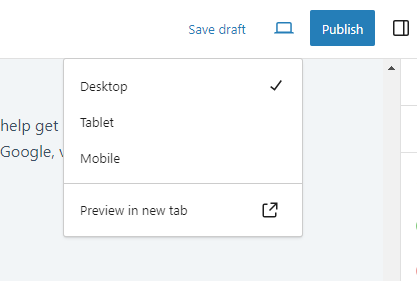
Make sure the images are responsive and change size according to the device they are being viewed on. If you are using WordPress, you can preview them for mobile, tablet or desktop before publishing.
Google Search supports images in the following formats: BMP, GIF, JPEG, PNG, WebP, and SVG. In my experience, WebP images are the lightest and do not compromise on quality.
If you add structured data, Google can view your images in rich results which are prominently featured at the top of search results.
Preview for Multiple Devices Before Publishing
Conclusion
Multimedia files are the second most important part of a web page after “text”. Optimizing them increased the speed of your website which boosts your SEO score. Further, a well designed multimedia file captures the attention of the reader and helps in much greater user-retention.
Long-tail keywords add depth(context, explanation, FAQs) to the content that you already have on your website. By adding depth, they make your website more authoritative in front of Google and therefore add to your EEAT rankings.
A higher EEAT rating put together with a couple of decent backlinks, could easily propel your website to rank higher on Google.
What are Long-Tail Keywords?
Long Tail keywords are those phrases that dive deeper into any topic or seek to address specific concerns around that topic.
For example, if we consider a topic on books, the word “Fiction Books” is the main or short-tail keyword while the search phrase “Top 10 Fiction Books From Victorian Era” is a long-tail keyword.
Note how the long tail keyword dives deeper into the main topic of fiction books.
Long-tail keywords not only add more depth to the content available on your website but also helps you gain topical authority. This topical authority, an integral part of your EEAT is a critical ranking factor on Google.
Long-tail Keywords Add Depth
Long-tail keywords are those topics that go in-depth and are more specific in explaining a core topic.
For example, for the core keyword “geography books“, a long-tail keyword would be “Best Geography Books for Undergrad Level“. Note that it contains the core keyword and goes in-depth to explain which geography books are the best for the undergrad level.
These keywords add depth to the content that is already present in your website by explaining a core topic in a specific manner.
Long-tails Help Increase Your Google Rankings
Google EEAT Rules
Google depends on EEAT ratings for a website to consider it fit for the Google search engine. EEAT stands for Experience, Expertise, Authority, and Trust.
The scope of this article is limited to Authority, however you can read the full article on EEAT.
Authority is the measure of how a website can be a go-to source for a certain topic. Google ranks websites in order of how much they match with the EEAT guidelines.
The authoritativeness of a website is usually seen from the fact that how many SEO-optimized articles the website has on a given topic. The more high-quality articles the website has on a certain topic, the higher its EEAT rating should be and, therefore, its Google ranking.
In my experience as an SEO, I have observed that since 2018 it takes at least 100 in-depth pages (or articles) at least to be considered an authority over that certain topic. The number varies from topic to topic and even reaches 1000+ articles for some YMYL niches.
Best Usage of Long-tail Keywords
The best way to use long-tail keywords is through a combination of content clusters, internal links, and external links. Posting standalone articles that do not have links to other pages around the same topic will not help in getting a good EEAT score.
To make the best use of long-tail keywords, make sure that it has a central core topic, and there are several long-tail articles that are linked to the core topic as well as with each other. This helps google index all the articles and group them together, which in turn helps boost your EEAT score.
How to do Long Tail Keyword Research?
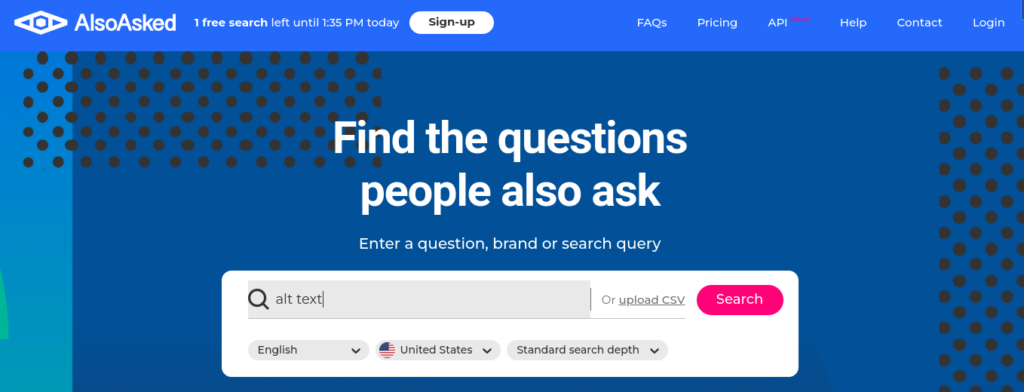
Also Asked
Also Asked is a premium keyword research tool but also has a free plan for users. The tool is used to search for long tail search queries from Google.
You just need to enter the short tail keyword.
Then select the country for which you are performing keyword research.
After that, you can press enter to search for the keywords.
There is also an option to increase the search depth which increases the number of related keywords in the search results.
Also Asked Homepage, A Tool For Long-tail Keyword Research
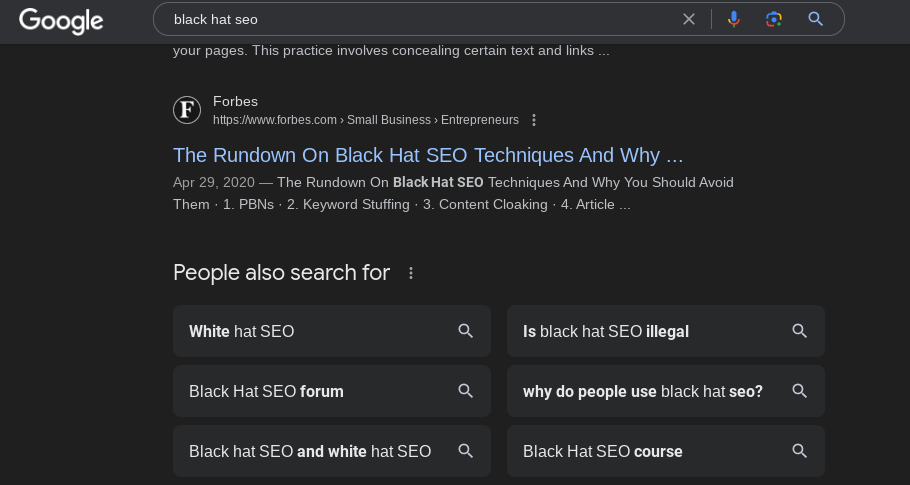
Google Search
At the end of each Google search page, you will find a list of keywords that are related to your search term. Those search terms are also long-tail keywords. You can pick them to create additional articles.
However, do not use those terms for a single skyscraper article. If you use multiple related keywords in a single article, it would amount to keyword stuffing which is a black hat SEO practice.
During my initial days as an SEO, we had tanked a crypto news website while creating skyscraper articles with related search terms as subtopics.
Below is an example of related search terms on Google which can also be used for Long-tail Keyword Research.
Related Search Terms on Google can be used for Long-tail Keyword Research
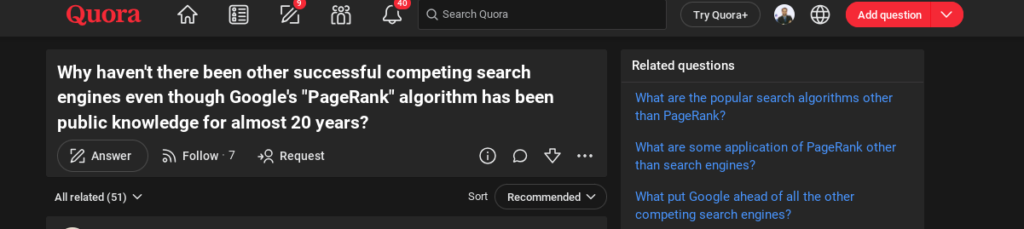
Quora
Quora is my favorite place for long-tail keyword research because we can get all the related questions in one place. The side panel on the website shows related questions which shows more questions for your long-tail keyword research.
Quora is one of the Best Places for Long Term Keyword Research
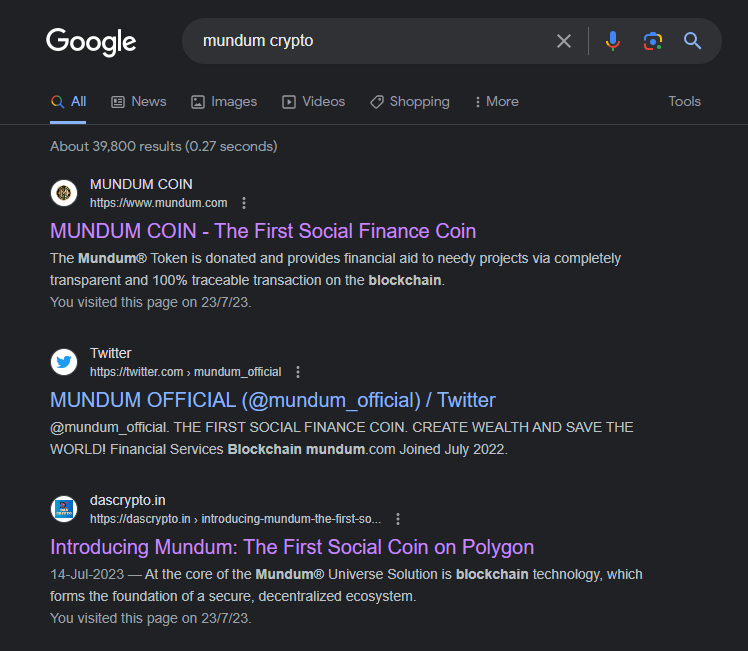
Das Crypto is a sister site of Ingeniare AI Marketing and shares news on developments in the world of cryptocurrencies, blockchain and DeFi. It was approached by a Web3 social coin, Mundum for a PR.
To demonstrate our SEO capabilities we ranked it on Google for several terms like:
mundum coin
mundum crypto
At the end of our exercise, we were able to rank our article on Google Page 1 just below the original website (mundum.com).
How We Ranked Das Crypto for Mundum
Das Crypto was ranked with Mundum with only On-Page SEO.
In Google Rankings, a secret be beat other competitors is through doing SEO better and faster than them. We published the Mundum PR as soon as we received it but after a little bit of optimization.
We made sure the text does not appear as just a wall and divided the entire content in subtopics.
Then we inserted images and graphics to help with visual appeal.
We made sure our text resonates better with Google Helpful Update guidelines which is ignored by several SEOs.
Backlinks were created from a few trusted platforms. This is where most people meet failure because they create unnecessary backlinks which harm the website.